Here’s a sample Waterfall Project Plan with a typical structure, divided into phases. The Waterfall methodology is sequential, meaning each phase must be completed before the next one begins. The sample data provided includes phases, tasks, durations, dependencies, and deliverables.
Sample Project: Website Redesign
Project Overview
Objective: Redesign the company website to improve user experience and optimize for mobile devices.
Phase 1: Requirements Gathering (2 Weeks)
Task ID
Task Name
Duration
Start Date
End Date
Dependency
Deliverables
1.1
Identify Stakeholders
2 days
01-Oct-2024
02-Oct-2024
–
List of stakeholders
1.2
Conduct Stakeholder Interviews
5 days
03-Oct-2024
07-Oct-2024
1.1
Interview notes
1.3
Gather Website Requirements
5 days
08-Oct-2024
12-Oct-2024
1.2
Requirements document
1.4
Review and Approve Requirements
3 days
13-Oct-2024
15-Oct-2024
1.3
Approved requirements document
Phase 2: Design (3 Weeks)
Task ID
Task Name
Duration
Start Date
End Date
Dependency
Deliverables
2.1
Create Wireframes
5 days
16-Oct-2024
20-Oct-2024
1.4
Wireframes
2.2
Review Wireframes with Stakeholders
3 days
21-Oct-2024
23-Oct-2024
2.1
Feedback on wireframes
2.3
Create High-Fidelity Mockups
5 days
24-Oct-2024
28-Oct-2024
2.2
Mockups
2.4
Review and Approve Design
3 days
29-Oct-2024
31-Oct-2024
2.3
Approved design
Phase 3: Development (4 Weeks)
Task ID
Task Name
Duration
Start Date
End Date
Dependency
Deliverables
3.1
Set Up Development Environment
3 days
01-Nov-2024
03-Nov-2024
2.4
Development environment ready
3.2
Develop Frontend Components
10 days
04-Nov-2024
15-Nov-2024
3.1
Frontend code
3.3
Develop Backend Services
10 days
04-Nov-2024
15-Nov-2024
3.1
Backend code
3.4
Integrate Frontend and Backend
5 days
16-Nov-2024
20-Nov-2024
3.2, 3.3
Integrated codebase
3.5
Initial Internal Testing
5 days
21-Nov-2024
25-Nov-2024
3.4
Bug reports
Phase 4: Testing (2 Weeks)
Task ID
Task Name
Duration
Start Date
End Date
Dependency
Deliverables
4.1
Functional Testing
5 days
26-Nov-2024
30-Nov-2024
3.5
Test report
4.2
User Acceptance Testing (UAT)
5 days
01-Dec-2024
05-Dec-2024
4.1
UAT feedback
4.3
Fix Bugs and Issues
5 days
06-Dec-2024
10-Dec-2024
4.2
Finalized code
Phase 5: Deployment (1 Week)
Task ID
Task Name
Duration
Start Date
End Date
Dependency
Deliverables
5.1
Prepare Deployment Plan
3 days
11-Dec-2024
13-Dec-2024
4.3
Deployment plan
5.2
Deploy to Production
2 days
14-Dec-2024
15-Dec-2024
5.1
Website live
5.3
Post-Launch Monitoring
3 days
16-Dec-2024
18-Dec-2024
5.2
Monitoring report
Phase 6: Project Close (1 Week)
Task ID
Task Name
Duration
Start Date
End Date
Dependency
Deliverables
6.1
Conduct Project Review
3 days
19-Dec-2024
21-Dec-2024
5.3
Lessons learned document
6.2
Project Closeout
2 days
22-Dec-2024
23-Dec-2024
6.1
Final project report
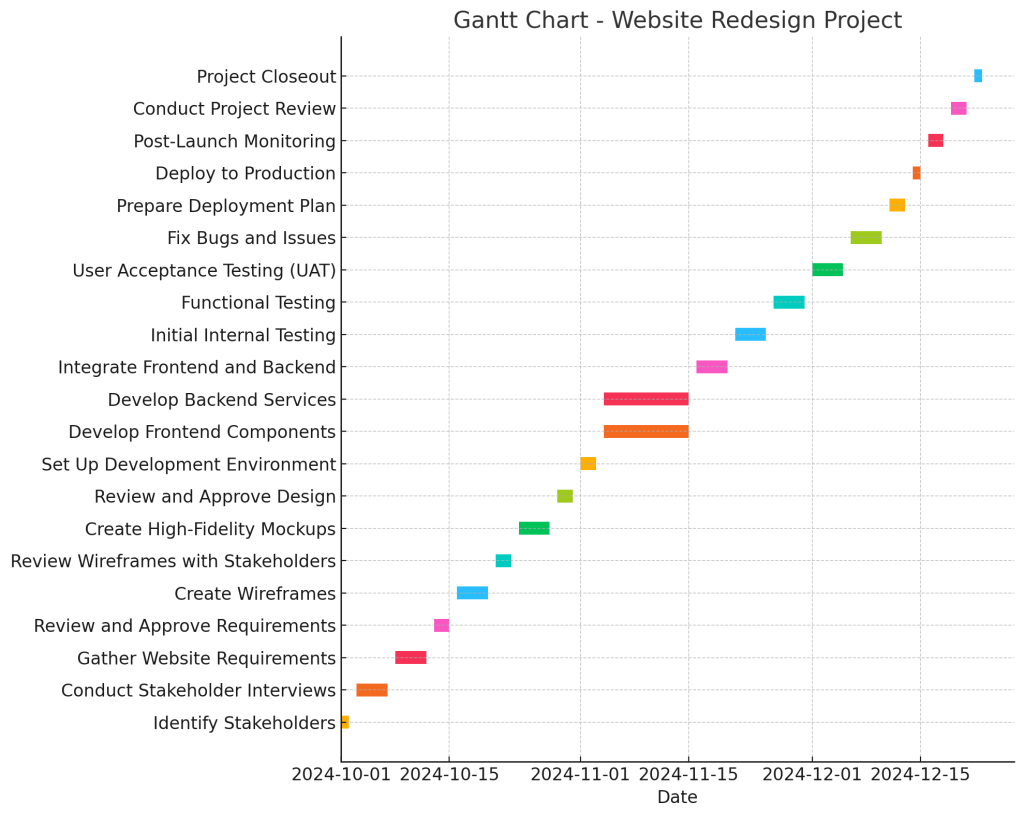
Gantt Chart Overview
The tasks in this Waterfall project plan follow a linear progression. For a visual representation, a Gantt chart could be used to show dependencies and timelines for each phase.
Sample Timeline
Start Date: 01-Oct-2024
End Date: 23-Dec-2024
Total Duration: ~3 months
Key Points
Dependencies: Each task relies on the completion of the previous one (except where parallel development work happens in Phase 3).
Deliverables: At the end of each phase, specific deliverables are provided to stakeholders for approval.
Risk Management: The Waterfall method allows for structured review at each phase to avoid scope creep or missed deliverables.


 PMO Info
Leave a comment