

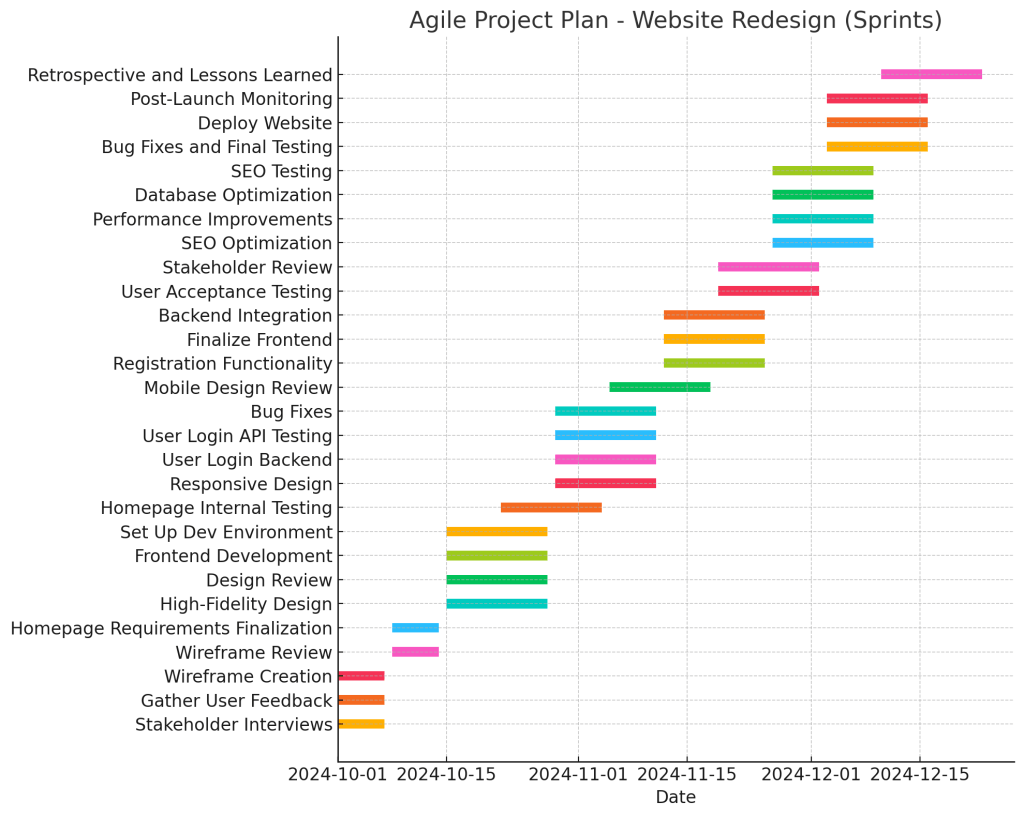
In Agile, projects are broken down into smaller, iterative cycles called sprints. Instead of following a linear path, Agile teams work on incremental progress and adapt to changes throughout the process. Here’s a sample Agile project plan for the same website redesign use case.
Project Overview
Objective: Redesign the company website to improve user experience and optimize it for mobile devices using Agile methodology.
Sprint Structure
- Sprint Duration: 2 weeks
- Total Sprints: 6 (with a potential backlog for future sprints)
- Team Roles: Product Owner, Scrum Master, Development Team, Designers, QA Testers, and Stakeholders.
Backlog Preparation
Product Backlog
The product backlog is a prioritized list of features, bug fixes, improvements, and tasks for the website redesign.
Sample Backlog:
- Responsive design for mobile devices.
- Improve website load time.
- New homepage layout.
- User login and registration.
- Content management integration.
- SEO optimization for all pages.
- Bug fixes and testing.
Sprint Plan
Sprint 1: Requirements & Initial Design (2 weeks)
Goal: Gather initial requirements and create the wireframe for the homepage.
| Task ID | Task Name | Assignee | Estimated Hours | Story Points | Status |
|---|---|---|---|---|---|
| 1.1 | Conduct stakeholder interviews | Product Owner | 10 hours | 5 | Done |
| 1.2 | Gather user feedback for the website | Product Owner | 8 hours | 3 | In Progress |
| 1.3 | Create wireframe for homepage | Designer | 15 hours | 8 | To Do |
| 1.4 | Review wireframe with stakeholders | Scrum Master | 5 hours | 3 | To Do |
| 1.5 | Finalize requirements for homepage design | Team | 5 hours | 2 | To Do |
Sprint Review: Present wireframes and homepage design draft for feedback.
Sprint 2: High-Fidelity Design & Initial Development (2 weeks)
Goal: Finalize homepage design and begin initial frontend development.
| Task ID | Task Name | Assignee | Estimated Hours | Story Points | Status |
|---|---|---|---|---|---|
| 2.1 | Create high-fidelity design for homepage | Designer | 12 hours | 5 | Done |
| 2.2 | Review design with stakeholders | Product Owner | 6 hours | 3 | Done |
| 2.3 | Begin frontend development for homepage | Developer | 20 hours | 8 | In Progress |
| 2.4 | Set up development environment | Developer | 10 hours | 5 | Done |
| 2.5 | Internal testing of homepage layout | QA Tester | 8 hours | 3 | To Do |
Sprint Review: Homepage design completed, initial development demo for the team and stakeholders.
Sprint 3: Responsive Design & Backend Integration (2 weeks)
Goal: Implement mobile responsiveness and begin backend integration for user login functionality.
| Task ID | Task Name | Assignee | Estimated Hours | Story Points | Status |
|---|---|---|---|---|---|
| 3.1 | Implement responsive design for homepage | Developer | 16 hours | 5 | In Progress |
| 3.2 | Develop user login backend functionality | Backend Dev | 20 hours | 8 | To Do |
| 3.3 | User login API testing | QA Tester | 12 hours | 5 | To Do |
| 3.4 | Fix bugs from sprint 2 feedback | Developer | 8 hours | 3 | To Do |
| 3.5 | Stakeholder feedback on mobile design | Scrum Master | 5 hours | 2 | To Do |
Sprint Review: Review responsive design and demo basic user login functionality.
Sprint 4: Full Homepage & Backend Completion (2 weeks)
Goal: Finalize homepage design, complete backend for user login, and work on registration.
| Task ID | Task Name | Assignee | Estimated Hours | Story Points | Status |
|---|---|---|---|---|---|
| 4.1 | Complete registration functionality | Backend Dev | 18 hours | 8 | To Do |
| 4.2 | Finalize homepage frontend development | Developer | 15 hours | 5 | To Do |
| 4.3 | Integrate user login and registration | Full Stack Dev | 10 hours | 5 | To Do |
| 4.4 | Conduct user acceptance testing (UAT) | QA Tester | 12 hours | 8 | To Do |
| 4.5 | Review with stakeholders | Scrum Master | 5 hours | 2 | To Do |
Sprint Review: Present completed homepage and user registration functionality for feedback.
Sprint 5: SEO Optimization & Performance Improvements (2 weeks)
Goal: Improve site performance and SEO, optimize for search engines and reduce load times.
| Task ID | Task Name | Assignee | Estimated Hours | Story Points | Status |
|---|---|---|---|---|---|
| 5.1 | Implement SEO improvements | Developer | 10 hours | 5 | To Do |
| 5.2 | Reduce website load times | Developer | 15 hours | 5 | To Do |
| 5.3 | Optimize database queries | Backend Dev | 12 hours | 5 | To Do |
| 5.4 | Test SEO and performance | QA Tester | 8 hours | 3 | To Do |
Sprint Review: Show progress on website speed and SEO optimization.
Sprint 6: Final Testing, Deployment, and Project Close (2 weeks)
Goal: Conduct final testing, deploy the website, and project wrap-up.
| Task ID | Task Name | Assignee | Estimated Hours | Story Points | Status |
|---|---|---|---|---|---|
| 6.1 | Final bug fixes and testing | Developer | 10 hours | 5 | To Do |
| 6.2 | Deploy website to production | DevOps | 5 hours | 3 | To Do |
| 6.3 | Post-launch monitoring | DevOps | 8 hours | 5 | To Do |
| 6.4 | Retrospective and lessons learned | Team | 5 hours | 2 | To Do |
Sprint Review: Final demo, feedback, and project closure.
Agile Ceremonies
- Sprint Planning: Held before each sprint to discuss the backlog and select tasks.
- Daily Standups: 15-minute daily meetings to discuss progress, roadblocks, and updates.
- Sprint Review: At the end of each sprint, demonstrate progress to stakeholders and gather feedback.
- Sprint Retrospective: After each sprint, the team reflects on what went well and what can be improved.
Key Agile Principles in Action
- Iterative Development: Work is delivered in smaller increments, with constant feedback from stakeholders.
- Collaboration: Daily interactions between developers, designers, and stakeholders to ensure the project stays on course.
- Flexibility: Requirements are adapted as new information or feedback emerges after each sprint.
- Continuous Delivery: Working pieces of the project are delivered after each sprint, allowing the product to evolve.
 PMO Info
Leave a comment